


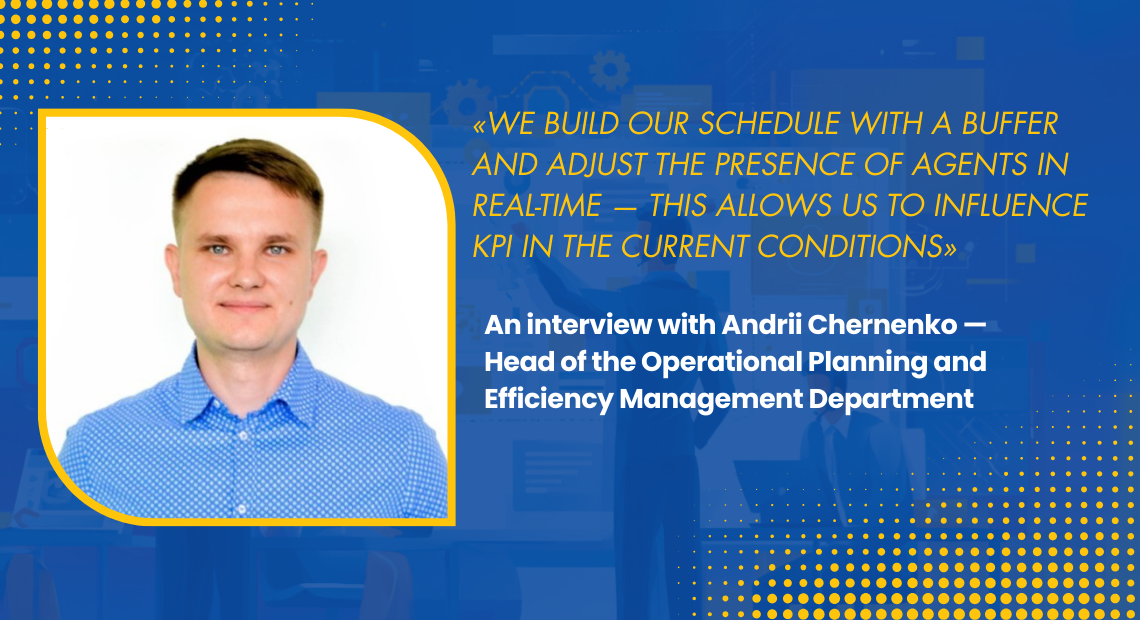
We continue our series of interviews with leading experts at Global Bilgi to show how contact center outsourcing works behind the scenes in an environment of constant challenges. Within this system, the role of the Operational Planning and Efficiency Management Department, responsible for service stability, predictability, and quality control, cannot be overstated.
Andrii Chernenko, Head of the Department, shared his experience and practical approaches to planning, real-time monitoring, and resource management during wartime, blackouts, and ongoing workforce shortages.
Andrii, you’ve been with the company for 17 years. How has contact center planning changed since businesses had to adapt to regular power outages?
“The transformation of our planning processes actually started back in March 2020, when we first faced COVID-19 and a widespread reluctance among employees to work from offices due to health concerns. This led to a sharp increase in resignations, and we quickly realized that we had to urgently shift to a remote contact center model. At first, we saw it as a temporary solution, but it eventually became permanent.
Step by step, we transitioned agents to remote work and updated our training, control, planning, and reporting processes. By the end of 2021, around 80% of our employees were already working remotely.
With the start of the full-scale war, new challenges emerged — both internal displacement within Ukraine and relocation abroad. However, thanks to well-established tools and refined processes, we were able to maintain up-to-date weekly schedules, enable shift swaps, and ensure continuous online performance monitoring by our monitoring specialists.
In the fall of 2022, we faced another major challenge — large-scale blackouts. At that time, about 80% of our employees were working from different regions across Ukraine, while another 20% were based abroad. This distribution allowed us to remain flexible in our planning, account for different outage conditions across regions, and maintain team performance even under such difficult circumstances.”
What role does your department play in keeping projects running smoothly during blackouts?
“Our department plays a key role in ensuring uninterrupted contact center operations, especially over the past five years, as the business has been constantly facing new challenges.
Our planning specialists analyze workload volumes, agents’ worked hours, forecast accuracy, and achieved KPIs. Based on this analysis, we adjust future schedules to improve forecasting accuracy.
Next, our monitoring specialists step in. They track actual workload and operational issues in real time and actively influence performance targets: managing channels, redistributing workload among agents, and building real-time dashboards to monitor KPIs. When needed, they coordinate shift extensions or reductions and move working hours between periods to stabilize the situation.
Our reporting specialists, in turn, prepare all required reports on a daily basis to support further analysis and informed decision-making.
Taken together, this integrated approach allows us to stay flexible and respond quickly to any challenges.”
How do you forecast workload and plan agent schedules when power outages vary by region and remain unpredictable?
“Forecasting power outages is impossible. Even officially published outage schedules often change and don’t reflect reality due to emergency shutdowns. That’s why we use a different approach.
We analyze historical performance data across different periods and, based on experience from similar situations, determine how many additional hours need to be built in to create a buffer that can compensate for potential agent unavailability. This allows us to build schedules with a margin, while our monitoring specialists make real-time adjustments to actual agent presence on the line.
If there aren’t enough agents available, we launch a process to approve shift extensions.
If there are more agents than needed and no workload, we coordinate a reduction in working hours. When possible, we also apply additional motivation mechanisms.
Of course, everything depends on the scale of the outages. If they are significant, we work in parallel on improving agents’ energy independence alongside schedule adjustments.
Taken together, these actions allow us to maintain and even improve KPIs despite such unstable conditions.”
Recommended reading: Headcount vs. FTE: How Many Agents Does Your Contact Center Really Need?
What tools and analytics help you respond quickly to peak volumes, service delays, and the risk of SLA breaches?
“All of our agents work within the Sirius cloud platform, which handles customer interactions and provides full operational control. Within this system, our monitoring specialists have built real-time dashboards for each project, displaying key contact center performance metrics.
This data is simultaneously available to monitoring specialists, agents, and their supervisors. Thanks to real-time analytics, we can immediately detect traffic spikes or potential risks to KPI performance and quickly take action:
- reroute workload to another team;
- engage agents from other lines of business;
- notify agents who are currently on break;
- quickly increase the number of active agents on the line.
Our monitoring specialists follow clearly defined action procedures for every scenario — from sudden peak loads to sharp volume drops. This structured approach allows us to respond promptly to any changes and maintain service stability.”
What solutions do you believe are most effective in maintaining service quality and availability during blackouts?
“In my view, the following solutions have proven to be the most effective:
- Improving the energy independence of remote agents. This includes providing agents with additional power sources. Given the frequency and duration of air raid alerts, even office-based work no longer guarantees operational stability.
- Having part of the workforce located abroad. This helps balance risks and maintain service availability across different time zones and energy conditions.
- Shift planning based on historical blackout data. When staffing levels allow, we proactively build in additional working hours to compensate for the potential unavailability of agents.
- A real-time monitoring team. These specialists clearly understand what actions to take during peak loads: managing and redistributing traffic across lines of business, controlling agent statuses, initiating shift extensions or additional shifts, managing performance, and using real-time dashboards and approved procedures.
- Routing simple customer inquiries to AI-based solutions. This reduces the load on agents and allows them to focus on more complex cases.*
Taken together, these solutions deliver strong results.”
Can you share examples where your team helped prevent a critical drop in service quality or availability during large-scale blackouts?
“It’s difficult to single out one specific case, because across all projects we apply an approach shaped by years of experience. For us, ensuring the stable operation of our clients’ contact centers is a fundamental priority, even under the extremely challenging conditions of war.
In practice, results are always the outcome of coordinated work across several teams. This includes planning and real-time monitoring on the PRM side, recruitment and training led by HR, technical support from IT, and motivation as well as individual support for agents provided by the operations team.
When all of these processes work in sync, the risk of a critical drop in service availability is significantly reduced, and service quality remains as stable as possible given today’s realities.”
You may also find interesting: 10 Questions for Yuliia Petrochenko, Head of the Operations Department at Global Bilgi
Today, the Ukrainian labor market is facing a significant talent shortage, as many young people have moved abroad. How does this impact workforce planning in contact centers, and what solutions do you see from an operational planning perspective?
“This is a challenge that simply cannot be ignored. The labor market is experiencing a serious shortage of talent, and the situation continues to worsen month by month. Contact centers have traditionally relied heavily on younger employees, so reduced hiring directly complicates the ability to build schedules that match actual workload and support target performance metrics.
In my view, addressing this challenge requires a comprehensive model that combines several key directions:
- Accessible and intuitive self-service channels for customers — such as mobile apps or personal accounts — where users can quickly find all the information they need about services.
- The use of AI-driven solutions, including chatbots and voice assistants, to handle simple and repetitive requests, with continuous improvement of their capabilities.
- A stronger focus for agents on complex, multi-step, and non-standard inquiries, along with ongoing analysis of contact topics and First Call Resolution (FCR) to improve both the quality and speed of support.
Taken together, these solutions make it possible to optimize resources more effectively and maintain stable service quality even under conditions of limited human capacity.”


