


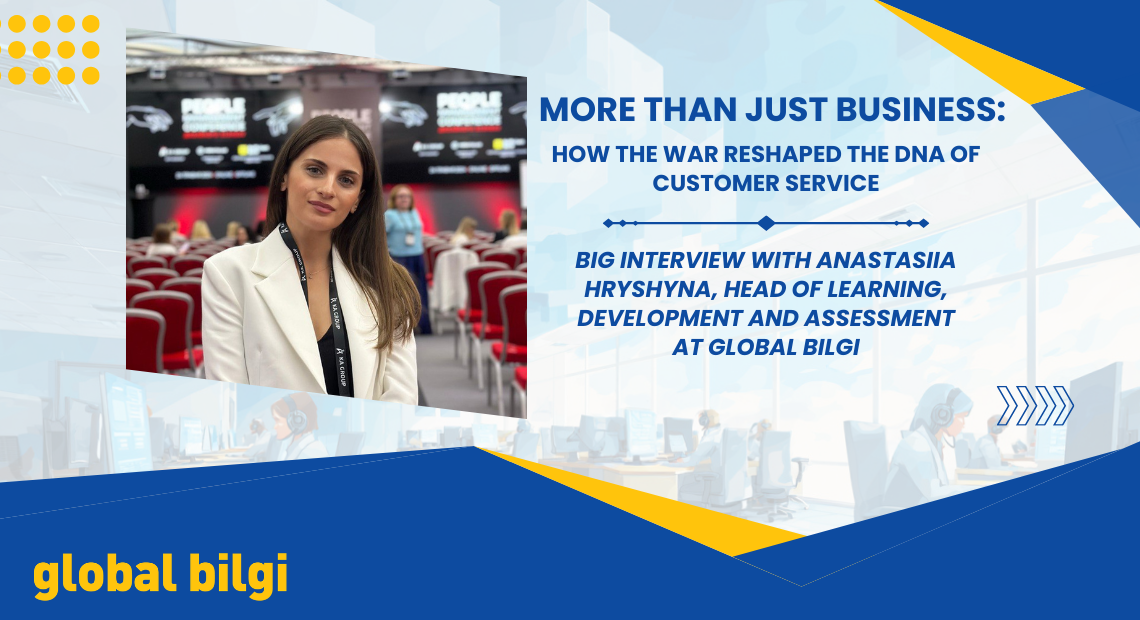
We continue our series of interviews with the key experts at Global Bilgi — the people shaping our service culture today and defining its future.
This time, I’m joined by Anastasiia Hryshyna, Head of the Learning, Development and Assessment Department. In this insightful conversation, we dive into how the war has transformed the approach to customer service, which skills have become mission-critical for agents, and why — once victory is won — service will never go back to being ‘just business’ as we knew it.
1.Anastasiia, could you share your professional journey with Global Bilgi with our readers? How has your role evolved, and what shaped your current philosophy on agent training?
My journey at Global Bilgi actually began in a leadership role as Head of Training, Development, and Performance Evaluation. This is somewhat of an exception for our company, as most of our managers are homegrown talents who started as frontline agents.
Before joining Global Bilgi, I worked in L&D across various sectors — retail, manufacturing, and healthcare. However, the outsourcing contact center was a completely different beast for me. It’s a fast-paced environment with a unique tempo, a higher level of responsibility, and a much more intense emotional workload.
Three years ago, we essentially had to hit the reset button on our training system. The full-scale war put many projects on hold; some programs became obsolete overnight, and we had to rebuild many processes from scratch. It was a period of both organizational and, more importantly, values-driven transformation.
Together with my team, we structured our corporate training system into two core pillars:
The first is deep product immersion. This covers everything from the initial training days to on-the-job nesting with mentors and final quality monitoring. For us, it’s not enough for an agent just to “know” things; they must be proficient in the systems, understand service algorithms, and be 100% ready to deliver high-quality support.
The second is systematic personal development. This includes corporate schools, internship programs, and paths for both horizontal and vertical growth. We invest heavily in soft skills: stress resilience, handling difficult customers, emotional intelligence, and the ability to work with feedback.
A special focus is placed on our Team Leads. Today, management competencies aren’t just a “nice-to-have” bonus — they are a critical necessity. It’s about the ability to support the team, keep them energized, and inspire them even under the toughest conditions.
My perspective on training was forged in the heat of this crisis. To me, it’s no longer just about knowledge transfer. It’s about creating an environment where people can grow, feel supported, and stay ready to deliver exceptional service — no matter the circumstances.
You might also enjoy: 7 Movies That Will Level Up Your Team Lead Skills in a Contact Center
2.The full-scale war has been a massive challenge for both the country and the business community. Have you noticed a shift in the people applying for agent roles? Do they truly grasp the weight of the responsibility they are taking on?
To be fair, I can’t offer a direct “before and after” comparison because I joined Global Bilgi about a year into the full-scale invasion. However, I can say this with certainty: today, we are all living and working in a state of constant instability. This reality directly shapes every person who walks through the doors of our contact center.
Air raids, shelling, blackouts, and a persistent sense of uncertainty have become the backdrop of our lives. You simply cannot separate that background from the work itself.
Since we operate primarily online — both for training and daily operations — professional responsibility now comes with a technical side: stable internet, backup power, and a reliable PC. Not every candidate realizes how critical this is right away. Sometimes, it only becomes clear during training that frequent power outages might physically prevent someone from being fully operational on the line.
At the same time, I see that the value of stability has shifted. Today, a job is about more than just a paycheck. It’s about having a foundation — predictable processes, a clear schedule, and a team that stands by you, even if that team is digital.
People crave support now more than ever, both human and informal. They need empathy and the recognition that behind every KPI is a real person with their own set of circumstances. I’ve noticed that many candidates have become more mindful; they have a clearer understanding of why they want this job and place a higher value on opportunities for professional growth.
The war has made us more vulnerable, yet somehow more “grown-up” at the same time. Today’s training system must account for more than just skills and knowledge it has to consider a person’s emotional state. After all, a team’s resilience begins with the resilience of each individual.
3.We hear a lot about empathy in customer service these days. In your view, how has the understanding of empathy evolved over the past few years, and how do you train agents to handle customers who may be under immense stress or in crisis?
With the full-scale war, the pressure on agents has skyrocketed. But the reality is that today, both the agents and the customers are under stress. This fundamentally changes the context of every interaction.
Often, it’s not just about providing information or closing a ticket; it’s about stabilizing the emotional state of the person on the other end of the line. If empathy used to be seen as a “nice-to-have” tool, today it is the foundation. However, we make a clear distinction between “scripted” and professional empathy. Customers can sniff out formal, canned phrases in an instant. The only thing that works is a genuine, timely reaction where the agent hears the emotion, acknowledges it, and helps guide the conversation toward a solution. But empathy isn’t about drowning in someone else’s pain; it’s about offering support while maintaining clear, professional boundaries.
We approach this systematically. From the very first days of product training, our trainers break down communication algorithms and emotional triggers. We then follow up with “soft skill” workshops on professional empathy: recognizing emotions, identifying the real underlying need, and building trust. We have a core “Ideal Agent” program, specific modules on handling conflict, and clear protocols for high-stress situations.
A major focus right now is also preventing agent burnout. Because empathy without an internal resource quickly leads to exhaustion.
I’d put it this way: today, empathy isn’t about being “soft.” It’s about maturity. It’s the ability to remain human in difficult circumstances while staying professional at the same time.
You might also find this useful: Average Speed of Answer (ASA) and Service Level (SL): The Connection Between Key KPIs of an Inbound Call Center
4.What is your take on the “Going the Extra Mile” philosophy? Should an agent go above and beyond their formal instructions to solve a customer’s problem?
I believe that “going the extra mile” is more about culture than anything else. It’s about the team spirit and the core values that make up a company’s DNA.
When someone starts doing just a little bit more, whether it’s taking extra care to explain something to a customer, covering for a colleague, or digging deeper into a complex case — it scales. Gradually, an environment is formed where support becomes the standard. And I truly believe that Global Bilgi is exactly that kind of company.
However, maintaining a balance is crucial. An agent’s priority is to resolve the customer’s request clearly, correctly, and professionally. An agent isn’t a psychologist or a rescuer. Their responsibility is to help within the framework of the process and their designated authority.
For me personally, doing a little extra is always about growth and setting a higher personal bar. When you realize that you didn’t just “finish a shift” but actually made a difference, you feel a sense of professional pride. That’s why it shouldn’t be forced. It has to be part of who you are and what you value.
5.Which new agent competencies have become pivotal during the war, and does the training process differ for teams serving mission-critical sectors?
Even before the war, Global Bilgi had established a framework of five core competencies, ranging from self-management and customer-centricity to digital mindset and coaching for managers. In 2023, we launched our proprietary “360 platform” to evaluate these competencies. Following the structural changes within the company in 2024, we began refining this model to align with our new strategic vision.
However, the war acted as a spotlight, clearly highlighting what is truly mission-critical for agents today. First and foremost is stress resilience. When a customer reaches out because of a loss of connectivity, a missing delivery, or any other life-essential service, the agent must remain calm and professional, even in the most high-pressure situations.
Second is genuine customer-centricity and empathy. This isn’t about formal politeness; it’s about the ability to sense a person’s state of mind, offer support, and provide a simple, practical solution.
Equally important are clear communication, attention to detail, and digital literacy. This includes the ability to process information quickly, navigate contact center systems seamlessly, and master new digital tools on the fly.
We have already implemented a new competency model across all contact centers within the DVL Group. It serves as a logical evolution of our previous framework but places a stronger emphasis on the skills that have become vital in today’s environment. Our next step is launching an updated 360-degree assessment for managers, which will eventually be rolled out to all employees.
6.How have your approaches to training and quality assurance evolved in a remote work environment?
With the onset of the full-scale war, we transitioned entirely to an online training format, which was a significant challenge. We needed to make the process not only effective but also engaging and alive, something that captures attention and keeps motivation high.
The duration of training depends on the specific project, ranging from a few days to two weeks. After that, the newcomer moves into nesting with a mentor, whom we call a First Call Assistant. This is where theory meets practice: the mentor provides real-time support during actual customer interactions, guiding them through the CRM, showing them how to find information quickly, and helping them structure the conversation correctly.
We’ve maintained a highly systematic approach: daily material refreshes, interim testing, and a final knowledge check. This is followed by a practical skills assessment during live calls. This ensures that the agent is fully prepared for independent work.
We have placed a special emphasis on gamification and content variety. Using our proprietary LMS platform, we create short, TikTok-style educational videos, host interactive quizzes, and run competitions. This adds a sense of dynamics and keeps remote learning from feeling like a chore.
This combination of online training, mentorship, gamification, and regular evaluation allows us to maintain high service standards even in a remote format. It helps new agents adapt quickly and feel confident on the line from day one.
7.Have business expectations for contact centers shifted during the war? What new challenges is your department tackling for your outsourcing clients today?
When a client chooses call center outsourcing, they are looking for one thing: results. This remains true regardless of what is happening in the country. Teams must be recruited, trained, and ready to provide seamless, high-quality service. During the war, this responsibility has only intensified.
My department takes full ownership of training new teams tailored to a specific client’s needs. We develop customized training programs, process the materials and resources provided by the client, and blend them with our own expertise. This creates a full-cycle onboarding process: from initial training and testing to nesting and going live.
Launching a new project is always a massive team effort involving planning, monitoring, financial calculations, and operational setup. But our area of responsibility is clear: to train people so they are fully prepared to represent the client’s brand. They must know how to handle objections and uncertainty, feel the support they so desperately need, and be able to apply their knowledge effectively in practice.
Beyond the core curriculum, we offer our own specialized training sessions that develop key skills and help agents perform at their best. We always adapt to the client’s unique requirements. For instance, for one of our BPO projects, we developed a custom conflict management training based on actual call recordings and real-life cases to make the learning as practical and relevant as possible.
8.Looking at the future of customer service through contact centers, what is your vision? In your opinion, why will service never return to being “just business” as usual?
I see the future of customer service becoming more human-centric, agile, and technologically integrated. Customers are no longer satisfied with standard answers or formal scripts. They expect rapid solutions, a personalized touch, and genuine attention.
Service can no longer be “just business” because competition is intensifying and expectations are evolving. Today, a company’s success is defined by the customer’s emotional experience: how comfortable they feel, and how well they are heard and understood. Even the smallest detail in a conversation can leave a lasting impression on customer loyalty.
Consequently, contact centers are transforming from mere request-processing hubs into centers for building trust and relationships. The agent’s skill set is expanding; it’s no longer just about technical product knowledge, but also about communication flexibility, empathy, rapid adaptation, and creative problem-solving.
Personally, I believe this trend will only accelerate. Companies that want to remain competitive must invest in the development of both people and technology simultaneously. Contact centers are where this balance comes to life — where a human approach meets technological efficiency.
In short, service can no longer be viewed as a “purely business function.” It is about experience, emotion, and trust. And that is exactly what the future of customer service will be about.
For us, maintaining a high standard of training is essential. It ensures the team is confident in their abilities, and the client receives consistent service quality, even under the most challenging circumstances.


