


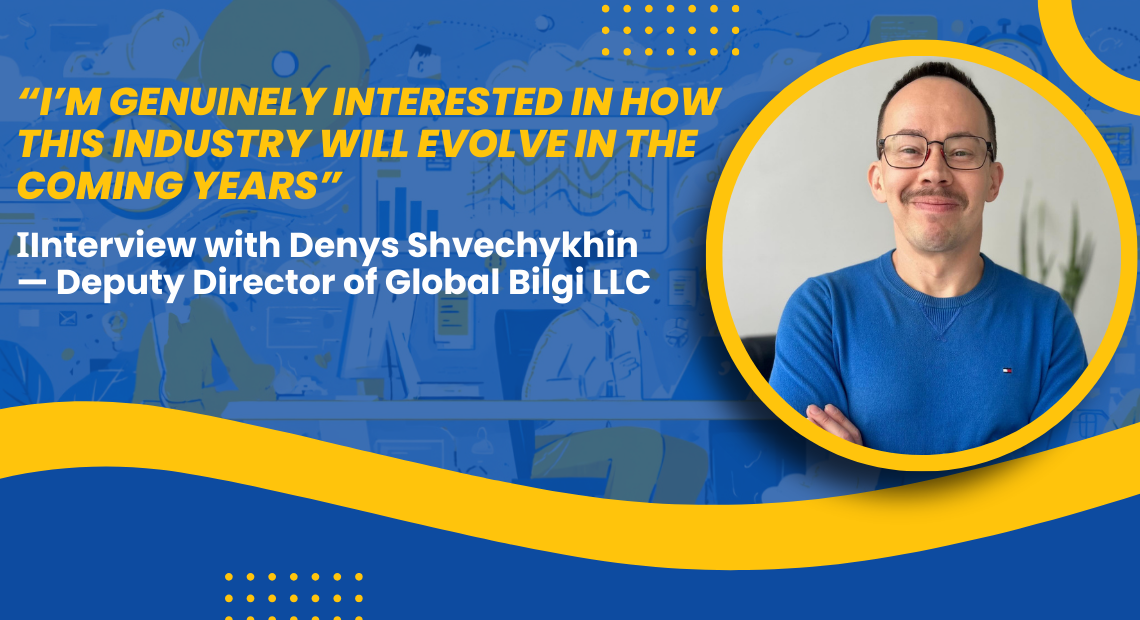
More than fifteen years at Global Bilgi — from chief financial officer to company head. Over that time Denis Shvechykhin has watched the market shift, business demand evolve, and learned what truly matters to clients. In this interview he talks about his journey and shares his perspective on the future of contact center outsourcing in Ukraine.
Denis, tell us about your path at Global Bilgi. How has your view of contact center outsourcing changed over time?
“Global Bilgi was founded in 2008 as a professional outsourcing contact center. The main shareholder was Turkcell, a Turkish telecom giant. Back then I was working at an audit firm, and after the 2008 crisis it became clear many foreign businesses were leaving Ukraine. I realized it was time to look for new opportunities. I applied for a CFO or chief accountant role at the newly formed company, passed the interview, was invited to Istanbul to meet the CEO, and received an offer there.
Until 2023 I served as Global Bilgi’s CFO. Finance is a fairly conservative function, so for a long time my view of the business stayed within those boundaries. Over 15 years in finance I hardly felt radical change. Everything shifted when the previous company director moved on and I applied for the vacant role.
As CEO I started seeing the company not as a finance lead but as a manager responsible for all processes. That’s when I really felt the scale of transformation in the industry: automation, omnichannel, AI integration — the changes are massive and accelerating. In finance you work within stable frameworks, but in contact center operations everything is moving fast. It’s a whole new level of business development, and I’m glad to be part of it.”
It’s been more than a year since Global Bilgi became part of DVL Telecom. Tell us about Global Bilgi’s role within the united group and about your current responsibilities there.
“Within the united group of companies, I lead Global Bilgi as a separate legal entity. But beyond that, I actually oversee all outsourced contact center operations across the entire DVL Group, including a major project for one of Ukraine’s leading banks. So, you could say my workload has expanded: in addition to managing Global Bilgi’s own contact center, I’m responsible for the outsourcing contact centers of the whole group.
As for our place within DVL Group, everything is quite straightforward. Global Bilgi was originally created as a professional outsourcing contact center, and from day one we implemented top international best practices. Today, this expertise has become a real asset for the united group. We’re now sharing our standards, processes, and service models with colleagues across all DVL contact centers, and they’re gradually aligning their operations with our approach.
Being part of the group also gives us access to a broader talent pool and allows us to share resources between projects. For example, if one of the group’s contact centers needs to quickly scale up for a seasonal peak, we can reassign agents or launch joint recruitment efforts almost instantly. This creates a level of flexibility that’s difficult to achieve when working independently. In essence, the integration allowed us to preserve Global Bilgi’s expertise while gaining the resources needed for more ambitious projects.
Independent audits confirm that our quality standards are among the highest, and this is exactly the expertise we are now scaling across the entire group.”
You might also like: 10 Questions for Yuliia Petrochenko, Head of Global Bilgi’s Operations Department
What, in your view, is the biggest value for a company when partnering with an outsourced contact center?
“From a business standpoint, the most valuable thing is having consistent, high-quality, fast communication with customers. And that’s exactly where an outsourced contact center becomes a true bridge between the company and its audience. Very often a business simply doesn’t have the time or internal resources to fully manage its own contact center. There are strategic goals, product development, market challenges — and Customer Care is a discipline of its own that requires focus and expertise.
We take that part off their plate. For the client, this means stable service quality, clear analytics, and predictable performance metrics. Plus — cost optimization. The business no longer needs to invest in equipment, workstations, or contact-center software. We already have a full infrastructure in place, including our own IT solutions for contact centers, and we can adapt quickly to any scaling needs or new processes.
Essentially, a company gets a ready-to-run, technologically mature team that focuses entirely on customer service — helping improve service quality without extra operational effort or unnecessary costs.”
You spent many years as a CFO. From a financial perspective, why is outsourcing a contact center more cost-effective for businesses?
“Outsourcing helps companies eliminate a huge number of hidden costs that are often overlooked. Running an in-house contact center isn’t just about paying agents. It’s office rent, recruitment, training, onboarding, employee motivation, investments in hardware, IT infrastructure, licenses, service contracts, and the constant updates required to keep your software running smoothly.
On top of that, there’s turnover and in our industry it can reach 20% or more per month. That means nonstop hiring, training, onboarding, and a lot of manager time. As a result, the contact center gradually starts pulling resources away from the core business.
We take all of that on ourselves. The company gets a fully equipped team, a full technical infrastructure, and predictable service costs. So as a finance person, I’ll put it simply: outsourcing isn’t something to debate — it’s something to calculate.”
Can you share a commercial project where outsourcing a contact center delivered a truly tangible result for the client?
“One of the most illustrative recent cases comes from last year. One of our partners sent an official letter of appreciation to the Global Bilgi team for the exceptional quality of service we delivered. Their key metrics — Answer Rate, Service Level, and Average Speed of Answer — all improved significantly once we took over their customer support. The results made such a strong impression that we were invited to join a competitive tender, which we ultimately won. This led to an expansion of our collaboration.
I can’t disclose specific brand names, unfortunately, but I can say this: many companies continue to scale their partnership with us precisely because the outcomes speak for themselves. We don’t just manage inbound support. We also run outbound campaigns, conduct service audits, handle recruiting and training, and even develop custom software for our clients’ contact centers.
This gives our partners a wide range of benefits: cost optimization, improved service quality, and measurable growth in key performance indicators, including conversions.”
Recommended reading: Adapting Contact Center Software to Client Needs: The Toyota-Ukraine Case
Which projects best demonstrate Global Bilgi’s ability to scale teams quickly and adapt to clients’ needs?
“Speed and adaptability are absolutely crucial for any outsourcing contact center, and we have plenty of cases that prove our expertise in this area. One of the most illustrative examples is a project where the client decided to completely redesign their service model, shifting from multiskilled operators to a segmented customer support structure. Within just a few weeks, we retrained the entire team, updated the workflows, and transitioned all operators to a new software platform.
If we talk about flexibility on a broader level, we can’t ignore the transition to remote work. As early as the beginning of 2020, we saw that this shift was inevitable and started preparing in advance. What’s important is that we proactively communicated with all our partners, clearly explaining how we would secure data and maintain service quality. At that time, many doubted it was possible to move to a remote model quickly and without disruptions. But we invested in VDI licenses, built the necessary infrastructure, and the transition went almost seamlessly.
Today, most of our operators work remotely, fully compliant with all security requirements while delivering consistently high-quality service. It’s a strong example of how Global Bilgi doesn’t just react to new challenges, but responds proactively and effectively.”
And finally: what personally motivates you to continue developing the contact center outsourcing direction?
“Several things motivate me. First, I’m genuinely interested in how this industry will evolve in the coming years. We’re seeing a talent outflow from the country, and naturally the question arises: can technology — especially AI-driven solutions — partially or fully take over the functions of contact center agents? It’s a big challenge, and I want to be at the heart of that transformation.
Second, I’m motivated by our team. Both the young professionals who joined us in recent years and the people who’ve been with Global Bilgi through many stages of our journey. They bring energy, stability, and confidence that we can accomplish even more.
And finally, I’m driven by the desire to see our business not just survive difficult times, but grow and scale. Yes, it’s a complicated period for Ukraine, but I believe we can overcome these challenges and strengthen the position of the BPO industry as a whole.”


